Wellington, Windy Wellington, Wellywood, Pōneke or Te Whanganui a Tara. Pt I
- R.

- Mar 28
- 9 min read
These are a hell of a lot of impressions to process all at once. This is not going to be easy. My head is in complete chaos, brought on by the sensory overload this city keeps throwing at me. I should write faster. Faster still.
First of all: I do not remember who said it or when, but someone once told me Wellington was not all that exciting and not really worth visiting. Then on the Greenstone Hike I was told: at least go to Te Papa Tongarewa, the Museum of New Zealand. Now I am in the city and I have to admit, I am absolutely blown away. Not just by the museum, but by the city as a whole. Whoever said Wellington is just some typical capital with no flair, go wash your mouth out.
Roughly 200,000 inhabitants, tucked between harbour and hills, founded in 1840 by the New Zealand Company, capital since 1865, carrying the nicknames Windy Wellington and Wellywood, and the first one is well deserved, because it blows like crazy here. And home to the Hurricanes, the rugby team whose home match against the Queensland Reds from Brisbane I am going to attend later today. It should be obvious where my sympathies lie. First against fourth. Go Canes!
Let us start from the beginning. My first decision was of course to head straight to Te Papa Tongarewa. After a short walk along the waterfront, including the Moana statue, I was already standing at the entrance. Quick explanation: New Zealand residents do not pay admission, everyone else does, but it is absolutely affordable and valid for 48 hours. Since Maya had told me that the Breathe exhibition was supposed to be quite good, I booked that as well. And then I was in the museum. And my jaw dropped fairly quickly.
This museum is put together and curated with so much love, precision, and sensitivity that it is almost hard to comprehend. Very modern, very thoughtful, very clear. During my studies I often worked on exhibitions, setting them up and taking them down, accompanying them on an inland ship, I lived in Hamburg and worked for a company that designed objects and art installations for exhibitions. So I do think I have seen quite a bit. But here? Wow. Incredibly well done. Six out of five possible stars. So many themes in such a compact space, explained so well, realized with the newest technical possibilities. An earthquake house, interactive exhibits, visually outstanding presentation of content. And because of that, here are a few of the things I learned.
In the Māori creation story, the world comes into being through the separation of Ranginui and Papatūānuku. Ranginui and Papatūānuku are the Sky Father and the Earth Mother. From their separation comes the world of light, which is why nature, life, and origin are understood here as familial and alive. Papatūānuku is far more than simply earth. She is the origin of life, Earth Mother, and the place to which everything returns. What fascinated me was how strongly the feminine is embedded in this, because with Papatūānuku and later Hineahuone, the first woman formed from earth, this creation story feels entirely different from what we grew up with in Europe. It describes the world as a living connection between sky, earth, family, and origin. Papatūānuku stands for nurturing, birthing, life-giving force. Who the f&/k is Adam?
Then the kea. Because of the suspicion that kea killed sheep, at least 150,000 of them were shot or poisoned over roughly 130 years. At one point there was even a bounty of ten shillings per beak. One farmer is said to have killed 67 kea in a single night. The usual witch hunts. And then the kiwi, one of the strangest birds in the world, with nostrils at the tip of its beak and, as mentioned, enormous eggs in relation to its body. By the way, the male takes over most of the incubation, for up to 70 days.
Pounamu, also known as greenstone, occurs naturally only on the South Island and is far more than a decorative stone for Māori. It is taonga, a cultural treasure. Its extraordinary toughness made it ideal for tools, weapons, and pendants, and even today its origins remain closely connected to water, landscape, and whakapapa.
Then ANZAC and the World Wars. The Gallipoli exhibition on the traumatic and loss-heavy trench warfare fought there does not tell the war as some grand historical backdrop, but stays very close to individual people and to a defeat that later went looking for its heroes. It shows brutality, mass death, and all the abominations human beings so willingly inflict on one another. Especially powerful are the oversized figures by Wētā Workshop, which give the whole thing an almost suffocating force in the deliberately narrow spaces and intensify the exhibition’s impact even further. History suddenly becomes something immediate, physical, tangible. And of course, for everyone who studied chemistry in Stuttgart and had the honour of attending Professor Becker’s introductory lecture: who fell at Gallipoli? Exactly, Mosley.
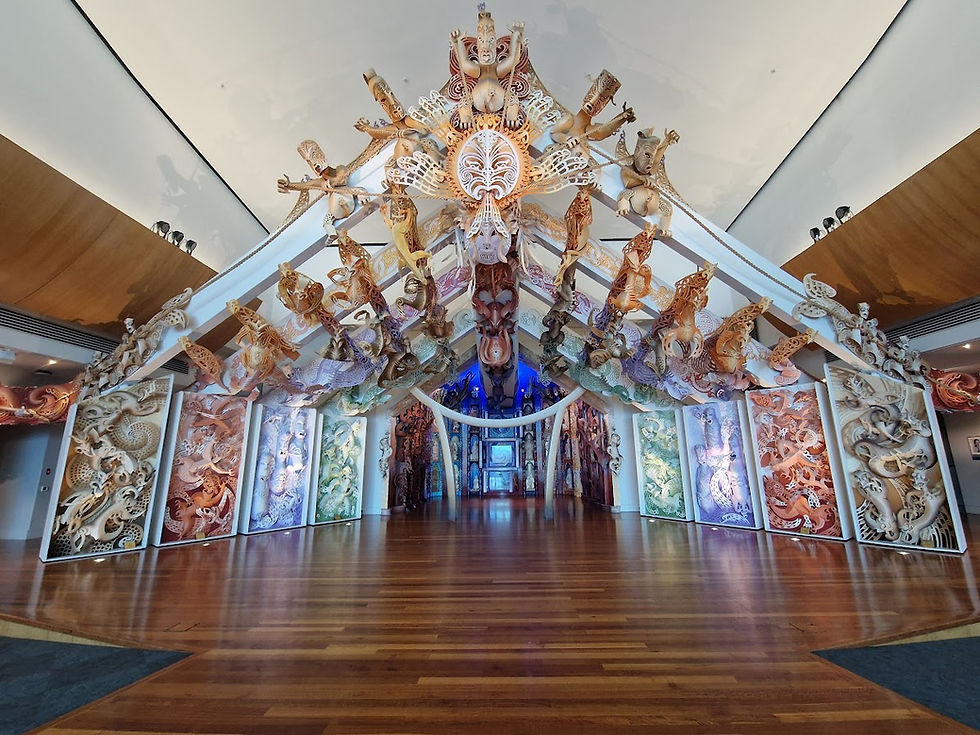
As for the title image: this is the interior of a modern Māori wharenui, a meeting and ceremonial house, namely Te Hono ki Hawaiki on the marae Rongomaraeroa. The many carved figures and ornaments are not mere decoration, but tell whakapapa, lineage, ancestors, myths, and the connection between people, nature, and the spiritual world. A space like this is at once artwork, place of identity, and sacred place of encounter, and it is simply incredibly beautiful and aesthetic.
At Te Papa, you do not just learn something about earthquakes, you almost feel them yourself. At the same time, the building itself is a small marvel of engineering, resting on 152 so-called base isolators designed to absorb seismic shocks. All the more remarkable, then, that the not-so-distant City Gallery Wellington is currently closed due to insufficient earthquake protection and is now being upgraded. For the time being it has moved into the National Library. I will get to that later.
A few random facts about New Zealand that you absorb almost incidentally in Te Papa are genuinely impressive. But above all, what you notice there is this real love for the country itself, for nature, and for history. And just to indulge in a bit of Aussie-bashing once again: from my point of view, Australia simply cannot win the direct comparison with its neighbour. This is just another level. Truly. In Brisbane you suddenly get an LGBTQ exhibition about the nineties and scene fashion dropped into the natural history museum somewhere between dinosaur bones and rows of taxidermied animals displayed with all the charm of a warehouse shelf. That alone already shows how little space, attention, and probably funding are often given to culture in Australia, and how indifferent some of it feels in execution. Sorry, dear Australians, do not take this German directness as an insult, but rather as encouragement to finally do better. A lot of it feels astonishingly unimaginative and carelessly slapped together. There are exceptions, though. In Melbourne the International Gallery of Art really makes an effort, the National Gallery is okay too, and the natural history museum in Adelaide also feels as though at least someone there wants to do more than just maintain appearances.
Back to Te Papa. I could barely get over my amazement. Everything felt incredibly lovingly curated, with a sure eye, taste, attention to detail, and at the same time a clarity that never turned preachy. I would have loved to carry away many more individual facts, but at some point even my little brain reaches its processing limit. What did stay with me, though, and what I had been missing the entire time in Australia, was this much clearer awareness of connections, between our actions, climate change, carbon-free approaches, and the protection of the environment. From the very first moment in New Zealand you can feel a different relationship to it.
It is the little things. You are asked whether you actually want a plastic lid for your coffee instead of one simply being slapped on without a second thought. Lids are often made of paper to begin with, reusable cups are normal, and paper bags dominate in supermarkets instead of plastic. Granted, in both countries you see comparatively little plastic rubbish lying around in the streets, greetings nonetheless to southern and southeastern Europe, where one sometimes wonders how people can treat their own environment like that. But in New Zealand people are noticeably more attentive to these details and to the contribution of the individual when it comes to climate and environment.
To really cement this point: in 2024, New Zealand’s electricity mix was 85.5 percent renewable. The largest share came from hydropower at 53.5 percent, followed by geothermal at 19.9 percent, wind at 8.9 percent, and solar at 1.4 percent. No nuclear power, and the Kiwis are especially proud of that. By comparison, Australia sits at 36 percent, Germany at around 56 percent, although of course one has to take Germany’s strong industrialization into account.
Then I thought this experience could hardly be topped, and went into the special exhibition Breathe, only to discover that it literally took my breath away. I have rarely, perhaps never, seen such a good digital exhibition, and one that was graphically so sophisticated at the same time. This is the sort of thing we dreamed of twenty years ago, when plasma screens, computers, and projectors were slowly making their way into larger installations and you could sense what might one day become possible.
Breathe | Mauri Ora is not a classical exhibition, but an immersive journey through the hidden rhythms of life, where everything revolves around breath, connectedness, and our relationship with nature. You move through large-scale digital worlds that take you from a single drop of water through tree roots, body structures, and organic networks all the way into almost cosmic spaces. Rather than just looking, you are drawn into a sensory staging of video art, meditation, and interactive moments that feels more like being pulled under than like an ordinary museum visit. It was realized by the London collective Marshmallow Laser Feast, and what they have put on display here is, for me, simply world-class, and that in the southernmost capital on this planet.
What fascinated me most was how finely and yet powerfully the theme is handled: the influence of breathing on nature, flora, fauna, and human beings, the constant circulation, the connection between inside and outside, between body and world. I have always been fascinated by the conversion of oxygen into energy. Photosynthesis is, to me, one of the most complex and beautiful processes imaginable, just as breathing in animals, the transport of oxygen through the blood deep into the cells, and there the controlled burning of sugar. Extremely exciting, extremely complex, and almost impossible to fully grasp in its entirety, and here this immense subject is made experientially accessible in a graphic treatment of rare precision, beauty, and force. Nothing about it feels preachy, everything feels thought through, tasteful, and perfectly judged, and that is precisely why the exhibition hits so hard.
Rebirth at the exit of the special exhibition. The final sign reads: Now step out into the world, and take your first breath.
Indeed. That was it for me.
After this truly extraordinary experience, I first wandered around aimlessly. Following the coastal road, trying somehow to sort my impressions, I eventually reached the beginning of Mount Victoria and a steep wooden staircase leading upward. As a connoisseur of stair climbing, I naturally headed straight up to the lookout, where I sat down for a while, processed things, and did a bit of work. From up there you also understand why this city is called Windy Wellington. It really does blow like mad. The panoramic view over Wellington, the harbour, the islands, the hills, the airport with its vaguely Hollywood-style sign. The airport itself, with its runway squeezed right between sea and city. And of course everywhere in New Zealand there is also this Lord of the Rings feeling, Wellywood indeed, and in the park then Hobbits Hideaway and The Way of the Nazgûls.
I stood up there, and once again this unbelievable sensory overload came hammering down on me. There I was, trying to turn thoughts into words, and failing. Just wandering around on that summit, and suddenly someone spoke to me. Martin was standing there and pulled me back into reality. I needed a few seconds to fully return. That morning I had invited him to stay with me and do some laundry, and he had replied. But his message had landed in my spam folder, so I never answered. He must have figured out where he might find me, and behold, human intuition. What followed was one of those conversations about politics, decency, worldview, and our generation, raised analog, digitized later, and privileged enough to know both worlds. A conversation that lasted deep into the night. In that spirit.
I would have liked to describe my second day in Wellington here as well. In the National Library I saw He Tohu, one of the most impressive exhibitions in Wellington, where He Whakaputanga, Te Tiriti o Waitangi, and the Women’s Suffrage Petition are displayed. That really left a mark, and I wish I were already more sorted in my head. After all these images, themes, and thoughts, I need to let it settle properly before writing a separate article about it tomorrow. Massively impressive. But first I have to book the next few days. And then rugby.
P.S.: holy f&/king hell, this place is good!


Comments